Steven Capsuto, Translator
  • Home
  • Contact
Steven Capsuto, Translator

Steven Capsuto, Translator

  • Home
  • Contact
Follow me on

Archives: Projects

Poster for the play "Happiness" by Marilia Samper.
12

07. “Happiness,” a play by Marilia Samper

Poster for the play "Happiness" by Marilia Samper.

07. “Happiness,” a play by Marilia Samper

LIKE THIS 12

A full-length contemporary drama. Translated from Catalan to English by Steven Capsuto through a grant from the Catalandrama Project. Professional performance rights available.

In this well-crafted play, residents of a small apartment building almost come to blows over whether to install a wheelchair ramp that one of their younger neighbors needs.

The London professional production of my English translation (Cervantes Theatre, 2022) received enthusiastic reviews.

PRAISE FOR THE LONDON AND BARCELONA PRODUCTIONS:

“Astonishingly compelling… The ninety minutes flew by in this edgy and intense production.” – LondonTheatre1, 2022

“Not to be missed… One of the most beautiful stories I’ve seen recently… The characters are complex and full of contradictions, just like in life.” – El País, 2017

“The script never loses steam. It approaches its sensitive subject without any of the mawkish preachiness that could have undermined it. The playwright leaves theatergoers wondering what they would do in this situation.” – El Periódico (Barcelona), 2017

“A moving play… [presented in a] beautifully succinct translation by Steven Capsuto.” – Latino Life UK, 2022

“Hard cases make bad law, but as Marilia Samper’s play (beautifully translated by Steven Capsuto) proves, they can make good drama.” – Broadway World UK, 2022

—

Members of the New Play Exchange can find out more about this script at https://newplayexchange.org/script/3227259/happiness-by-marilia-samper.

Three hardback books
11

06. “The Posen Library of Jewish Culture and Civilization”

Three hardback books

06. “The Posen Library of Jewish Culture and Civilization”

LIKE THIS 11

An illustrated ten-volume anthology of Jewish cultural and historical texts spanning more than 3,000 years. Yale University Press, 2012–2028.

I’m part of a huge team of translators working on this project. I have 17 translations in volume 5 (Early Modern Era, 1500–1750) and will have still more in volume 4 (Late Medieval Era, 1200–1500), which comes out in 2027. Since 2019, I’ve been the Posen Library’s main Ladino-to-English translator, and they’ve also hired me to translate medieval and early modern literary, religious, scientific, and historical documents from Catalan, Portuguese, and Spanish. These are sizable books: volume 5, for instance, contains more than 1,300 pages.


Order Posen Library volume 5
4

05. “In It for the Dough,” a comedy by Cristina Clemente and Marc Angelet

05. “In It for the Dough,” a comedy by Cristina Clemente and Marc Angelet

LIKE THIS 4

A full-length contemporary comedy. Translated from Catalan to English by Steven Capsuto through a grant from the Catalandrama Project. Professional performance rights available.

This hit play premiered in Barcelona in 2022 to positive reviews before playing three seasons in Madrid. A Buenos Aires production opened in 2024. Other stagings have opened or been announced in Peru, Argentina (Cordoba), Colombia, Mexico, Ecuador, Bulgaria, and Greece.

THE CRITICS SAY:

“The twist ending delighted the audience.” –Diario Crítico, 2023

“A solid boulevard comedy… The audience has so much fun that after each scene, they burst into applause as if the actors had just sung an aria.” –Time Out Barcelona, 2023

“Pathos, humor, drama, and subtle irony combine in a script exploring human insecurities.” –El Periódico, 2022

“The kind [of comedy] that gets you both laughing and thinking.” –La Nación, 2024

SYNOPSIS:

Overbearing celebrity baker TONY ROCCO has a cultlike following. His life-changing retreats for adults combine bread making, self-help, and unpredictable mind games. Tony’s three current students are BRUNO (an earthy-crunchy spoiled rich kid), LAURA (an earnest, naive young conservative Christian), and NINA (a pragmatic, cynical cardiologist). They all have secrets, and not everyone is who they claim to be.

While inspiring raucus laughter, In It for the Dough explores questions about the need to believe in something or someone, and how easily we self-sabotage by pursuing shiny, unfulfilling goals.

Theater poster for the play America.
10

04. “America,” a play by Sergi Pompermayer

Theater poster for the play America.

04. “America,” a play by Sergi Pompermayer

LIKE THIS 10

A full-length contemporary play. Translated from Catalan by Steven Capsuto through a grant from the SGAE Foundation. Professional performance rights available.

America played in Barcelona in 2022–2023 at the Villarroel Theater to positive reviews before going on tour. It returned to the Villarroel in late 2023.
 

SYNOPSIS:

KAYLA, a young Black woman from Barcelona, is a drama student who works in a pub in London. Her boyfriend MAX, also Spanish, is a rich white undergrad studying finance. KAYLA is invited to his parents’ mansion outside Barcelona for Max’s birthday: a small gathering in the garden next to the former stables.

Max’s father, ANTONI, a billionaire hotel magnate from an old-money family, distrusts Kayla and is appalled at his son’s new progressive ideas. Whenever the conversation gets too tense, Max’s mother, CRISTINA, changes the subject and drinks more alcohol.

Over dinner, Max’s grandmother, who has the beginnings of dementia, lets slip that the family’s generational wealth originated in the slave trade, something Max has never mentioned to Kayla.

From there, the play rams head-on into Spain’s longtime role in enslavement and the fact that some of today’s richest families in “respectable” industries first became wealthy by enslaving people of color. In this story, “America” is not just a continent: it’s also the name that was imposed on ENITAN, a 19th-century enslaved woman who appears in a few scenes.

The script also touches on issues of urban renewal and the endless acquisitiveness of some people who already have far more than they could ever need.
 

PRAISE FOR THE ORIGINAL PRODUCTION:

“**** Great theater.” –Time Out Barcelona

“A brilliant reflection on Catalonia’s slave-trading, slave-owning past.” –Marcos Goikolea, Teatre Barcelona

“Pompermayer depicts a toxic family environment with a frivolous, drunken mother; a cynical, unfaithful, manipulative father; a thoroughly naive son still very much an adolescent; and a grandmother with disabilities who becomes the catalyst for the conflict, establishing the link between past and present to powerful effect.” –Ara (Barcelona newspaper)

“Avoids the romanticized narrative often used to justify Catalonia’s role in [enslavement]… A fine piece of theater at the Villarroel, essential in every sense.” –Xavi Pijoan, Teatre Barcelona

Book cover: Amazônia by Sebastião Salgado
Standard
28

02. “Amazônia,” a book by Sebastião Salgado

Book cover: Amazônia by Sebastião Salgado

02. “Amazônia,” a book by Sebastião Salgado

LIKE THIS 28

Amazônia by Sebastião Salgado. Taschen, 2022. Translated from Portuguese to English by Steven Capsuto.
– Coffee table edition: 527 pp.
– Smaller edition: 191 pp.

THE CRITICS SAY:

“In stunning and captivating photos and text, Salgado delivers a piercing look at a lost world, still surviving but under immense threat.” ― ecowatch.com

“Amazônia speaks to the idea that humans can live on this planet in a sustainable way, through profiling the forest’s indigenous communities, and offering fresh perspectives on the forest itself.” ― CNN.com

“Amazônia, a stunning succession of black and white panoramas. Looking through his images, I feel the same awe I would feel in front of sublime paintings: serpentine rivers flow through seemingly limitless forests, sheer-sided rock escarpments vanish into skies, and apocalyptic clouds loom over wispy treetops.” ― The Guardian

“Sebastião Salgado has spent more than two decades documenting the complex lives of Indigenous Amazonian people as they stand strong in the face of unrelenting colonial forces.” ― Scientific American

“Superb.” ― The Guardian

“An exceptional book on the beauty of this almost lost paradise, threatened by a galloping deforestation.” ― Le Soir

PUBLISHER’S BLURB:

For six years, Sebastião Salgado traveled the Brazilian Amazon and photographed the unparalleled beauty of this extraordinary region: the rainforest, the rivers, the mountains, the people who live there—this irreplaceable treasure of humanity in which the immense power of nature is felt like nowhere else on earth.


Order the coffee-table edition
Order the smaller edition
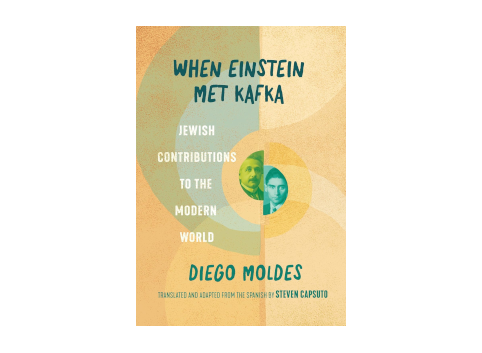
Book cover: "When Einstein Met Kafka" by Diego Moldes
Standard
23

03. “When Einstein Met Kafka,” a book by Diego Moldes

Book cover: "When Einstein Met Kafka" by Diego Moldes

03. “When Einstein Met Kafka,” a book by Diego Moldes

LIKE THIS 23

When Einstein Met Kafka: Jewish Contributions to the Modern World. Mandel Vilar Press, 2025. 620 pp. Translated and adapted from Spanish to English by Steven Capsuto.


“This landmark contribution by a leading cultural historian, Diego Moldes, is an original achievement: the fullest and most historically grounded study of Jewish intellectual and cultural achievements and contributions.” —Harvey Graff, Professor Emeritus of English and History, Ohio State University, author of The Literacy Myth and Searching for Literacy: The Social and Intellectual Origins of Literary Studies

“There is no book like this one, which examines the contributions of Jews as individuals (not as a religious people) to all fields of knowledge.” —Stuart Weitzman, world renowned shoe designer and entrepreneur


In April 1911, Prague artists, writers, and intellectuals gathered regularly at the Café Louvre, an intellectual center where music was played and high-level discussions were held. Many of the attendees were German-speaking Jews, such as Franz Kafka and his faithful friend Max Brod, Hugo Bergmann, Oskar Kraus, Franz Werfel, the mathematician Georg Pick, and a new arrival to the city, thirty-two-year-old Albert Einstein. Is it possible that Kafka and Einstein met and exchanged ideas? Did they influence each other from a philosophical or deep-thinking perspective?

Neither Kafka’s nor Einstein’s correspondence makes even the slightest mention of each other. But Einstein and Kafka, two icons of our modern era, serve as the starting point for this book on the enormous contributions in the fields of the empirical sciences, humanities, letters, and arts by individuals of Jewish origin in modernity. In this book, the reader will encounter numerous names in the pages that all spring from the fountainhead of these two antecedents, the Einsteinian and the Kafkian.

While Jews account for 0.2 percent of the world’s population and no more than 2.5 percent of any country except Israel, they have made some of the greatest contributions to Western Culture in diverse fields that range from physics and philosophy to music and art. One register of these contributions is Nobel Prizes: from its first recipients in 1917, 26 percent of awardees in the Nobel’s six fields — among them, physics, physiology/medicine, and economics — have been Jews. What accounts for the extraordinary breadth of these achievements? This is a question that Diego Moldes examines in When Einstein Met Kafka.

His answers include the history of Jewish culture itself, from Orthodox to secular, with its emphasis on literacy, learning, and especially inquiry and questioning. Until the European Enlightenment in the 18th century, Jews did not have full citizenship and civil rights — they were barred from universities, from government, and from entire professions. The Enlightenment opened the doors!

Despite the outbreaks of violent anti-Semitism—or what Diego Moldes calls Judeophobia—and continuing discrimination in all western countries, Jews now had legal rights, and they persevered. In a near-encyclopedic fashion, he profiles just how thousands of individual Jews, by name, made original contributions to fields as diverse as medicine, artificial intelligence, philosophy, history, economics, business, world finance, computing, sports, film, architecture, and more! The book itself is an extraordinary achievement, the result of twenty years of intensive research, yet written in an immensely engaging style.
 

ABOUT THE AUTHOR:

Diego Moldes, a Spanish essayist, novelist, poet, critic, and historian of cinema and culture—author of more than a dozen published books—holds a PhD in Information Sciences from Complutense University in Madrid, a BA in Advertising and Public Relations, and two MAs: one in Publishing and one in Foundation Management. In 2019, Galaxia Gutenberg published the original Spanish edition of When Einstein Met Kafka. His connection to Judaism led him to contribute articles to Raíces: Revista judía de cultura (Roots: A Jewish cultural magazine). From 2015 to 2018, he served as director-general (CEO) of Fundación Hispanojudía (the Hispanic-Jewish Foundation of Spain). In 2015, he became president and cofounder of ONG Asociación Fania (the Fania Association), a group that combats antisemitism and supports Jewish cultural endeavors.

Order the Book

Posts pagination

  • 1
  • 2

Featured posts

pretty-curly-young-woman-writing-notes-startup-project
The Easiest Way to Become a Successful
  • September 7, 2021
  • 4 min read
The Quickest Way to Deliver Your Message?
  • September 7, 2021
  • 4 min read
expressive-senior-woman-posing
Why We Don’t Have Technical Interviews for
  • August 15, 2021
  • 4 min read

Categories

  • Development
  • Gallery
  • Quote
  • Technician

Find Me

Tags

Art Fashion Happy Love Move Photography Travel

© 2025. All rights reserved by Steven Capsuto.